1. What Is a Custom Microfiber Pouch?
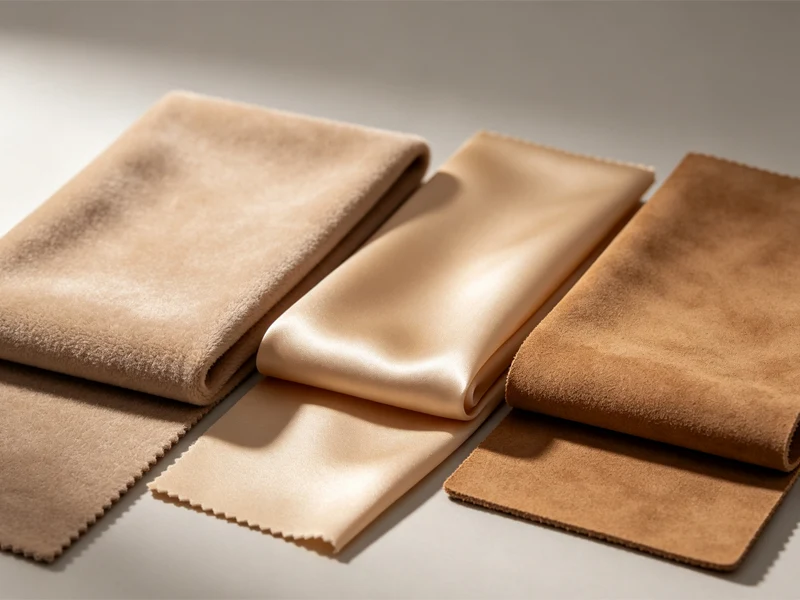
A microfiber pouch is a soft-touch bag or case made from micro-denier polyester suede — a brushed synthetic fabric engineered to feel like natural suede while resisting moisture, staining and colour fade far better than the real thing. Unlike velvet, which has a taller pile and softer drape, microfiber has a flatter, denser nap that holds its shape well, making it the material of choice for structured formats: fold-out jewelry organizers, zippered rolls, cable pouches and card holders.
"Custom" means every dimension can be specified to match your brand and product: overall size, internal compartment layout, closure type (snap, zip, tie-cord or elastic band), colour and logo method. There is no single "standard" microfiber pouch — the format follows the function, whether that's protecting a necklace in transit or organizing a set of charging cables in a travel bag.
Microfiber pouches serve the same three purposes as any fabric packaging — product protection (the brushed surface is scratch-safe for jewelry, watch cases and electronics), brand communication (debossed logos read as minimal and premium), and functional organization (multi-slot and fold-out formats keep small items sorted, which fabric pouches without internal structure cannot do).
Demand for structured microfiber packaging has grown alongside two trends: DTC jewelry brands wanting a travel-friendly alternative to rigid boxes, and tech/lifestyle accessory brands (cables, chargers, earbuds) needing scratch-safe soft packaging that also looks premium unboxed. Genesis has seen microfiber inquiries roughly triple since 2024, driven largely by jewelry brands and small-electronics sellers on Amazon and DTC storefronts.
2. Microfiber Materials Compared
"Microfiber" covers a range of weights and finishes. The fabric choice affects hand-feel, structure and price. Here are the options most commonly used in custom pouch manufacturing:
| Material | Feel & Structure | Best Logo Method | Relative Cost | Best For |
|---|---|---|---|---|
| Standard Microfiber Suede (180–220 gsm) | Brushed, soft-touch, holds shape well | Debossing, heat-press foil | $ | Jewelry organizers, card holders — the industry standard |
| Heavyweight Microfiber (240–280 gsm) | Firmer, more rigid drape, structured folds | Debossing, woven label patch | $$ | Multi-slot fold-out organizers, cable/tech rolls |
| Bonded Microfiber (with EVA/foam backing) | Stiff, structured, holds a fixed shape | Debossing, screen print | $$ | Watch rolls, rigid-feel travel cases |
| Recycled Microfiber | Similar to standard, slight texture variation | Debossing, screen print | $$ | Sustainability-positioned brands, EU market |
For most jewelry travel organizers and card holders, standard 180–220gsm microfiber suede offers the best balance of hand-feel, structure and price. Heavyweight and bonded microfiber are worth the premium for multi-slot fold-out organizers and cable/tech rolls, where the fabric needs to hold a fixed fold or internal shape without collapsing.
Recycled microfiber (typically GRS-certified) is increasingly requested by brands positioning around sustainability, since it avoids the animal-derived material questions that come with real suede while still using post-consumer or post-industrial recycled polyester. Genesis provides GRS chain-of-custody documentation with recycled-material orders — see our eco-friendly packaging options.
3. Standard Sizes & Formats
Unlike a simple drawstring pouch, microfiber packaging comes in several distinct formats, each sized around its function rather than a single width × height chart:
| Format | Typical Size | Contents Fit |
|---|---|---|
| Flap / envelope pouch | 9 × 12 cm – 12 × 16 cm | Single necklace, bracelet or earring pair |
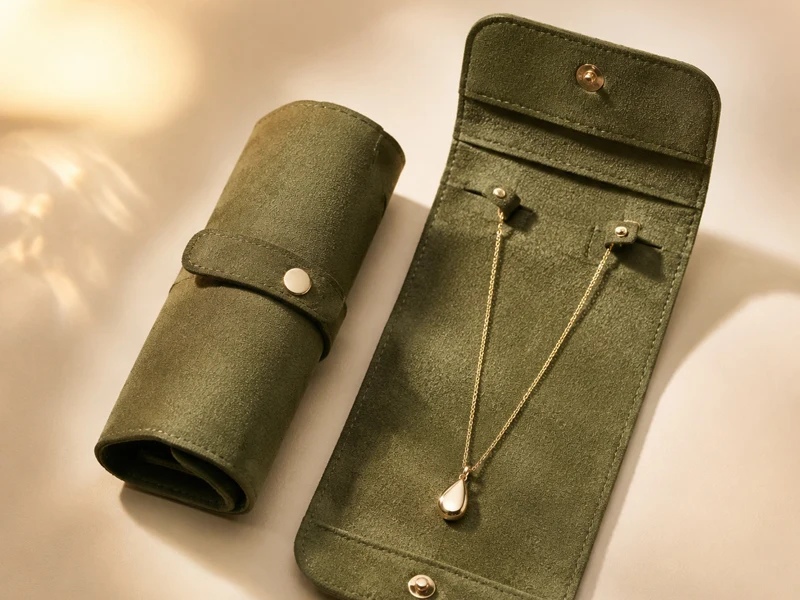
| Snap-flap roll (single item) | 10 × 20 cm rolled | One necklace or bracelet, presented open or rolled closed |
| Fold-out multi-slot organizer | 15 × 20 cm folded | 3–8 compartments for rings, earrings, chains |
| Zip-pocket jewelry roll | 12 × 18 cm rolled | Multiple pieces plus a zip pocket for loose items |
| Cable / tech organizer roll | 18 × 24 cm rolled | Charging cables, earphones, small adapters |
| Card holder | 10 × 7 cm | 3–6 cards, with or without a keychain tassel |
| Custom | Any specification | Engineered to your exact product dimensions |
Custom dimensions and compartment layouts are quoted within 24 hours at Genesis — supply the item dimensions and how many compartments you need, and we engineer the pattern accordingly. Multi-slot organizers typically require one extra sampling round to confirm compartment sizing before bulk production.
4. Colours & Branding
Standard microfiber colour libraries run 15+ colours from stock fabric, with no additional colour cost. Common choices include:
- Neutral, brand-forward tones: Beige, sand, tan, grey, black
- Jewelry-brand colours: Olive green, navy, burgundy
- Fashion/lifestyle tones: Pink, yellow, terracotta
Pantone colour matching is available for orders of 500 pieces or more per colour, with a colour-approved sample confirmed before bulk production. Allow 5–7 additional working days. Because microfiber is a synthetic knit rather than a woven textile, colour matching tends to be more consistent batch-to-batch than natural-fibre fabrics like cotton or linen.
Because microfiber has a flat, matte surface rather than velvet's reflective pile, colour reads more true-to-swatch under different lighting — useful for brands matching packaging to a specific brand colour across product photography, retail lighting and unboxing videos.
5. Logo Methods Explained
The logo method affects the appearance, durability and cost of a finished microfiber pouch. Three methods dominate professional manufacturing:
Debossing / Heat-Press Foil
- Clean, embossed-look logo pressed into the surface
- Minimal, premium aesthetic — our most popular method
- Works with or without foil colour fill
- Available from 100 pieces
- Best for: wordmarks, simple icons, monograms
- Not ideal for: complex multi-colour artwork
️ Screen Printing
- Full colour capability
- Best on flat panels (card holders, roll exteriors)
- Cost-effective for large runs
- Available from 100 pieces
- Best for: colourful logos, playful branding
- Not ideal for: heavily textured or folded surfaces
️ Woven Label Patch
- Sewn onto the flap or seam — very durable
- Distinct, tactile brand marker
- Works well on multi-slot organizers
- Available from 300 pieces
- Best for: brands wanting a garment-label look
- Not ideal for: very small pouches with limited seam space
The large majority of jewelry and lifestyle brands use debossing, sometimes with a tone-on-tone foil fill — it delivers a quiet, premium look that suits microfiber's matte surface and doesn't compete visually with the product inside. Screen printing is preferred by brands with colourful, illustration-driven logos.
6. Pricing & MOQ in 2026
Microfiber pouch pricing depends on five factors: format complexity, size, quantity, logo method and delivery timeline. The following price ranges apply to standard microfiber pouches ordered from a Chinese factory with established production processes:
| Order Quantity | Unit Price Range (USD) | Format | Notes |
|---|---|---|---|
| 100–499 pcs | $0.60 – $1.80 | Any format | Standard colours, standard sizes |
| 500–999 pcs | $0.45 – $1.30 | Any format including multi-slot | Pantone matching available |
| 1,000–4,999 pcs | $0.35 – $0.95 | All formats | Volume discount applied |
| 5,000+ pcs | $0.30 – $0.70 | All formats | Best pricing, dedicated production run |
These prices assume standard flap or envelope pouches (9×12cm–12×16cm). Multi-slot fold-out organizers and cable/tech rolls with internal stitching typically add 30–60% over a simple flap pouch at the same fabric weight, due to the extra cutting, stitching and assembly labour. Bonded microfiber with EVA/foam backing carries a further 15–25% premium.
Minimum order quantity (MOQ) for custom microfiber pouches at Genesis starts at 100 pieces per size and colour, across all formats — including multi-slot organizers. This is lower than many suppliers who set a higher MOQ for structured formats.
Need a Custom Microfiber Pouch Quote?
Genesis responds within 24 hours with detailed pricing, sample photos and a dieline. Factory-direct from Xiamen — no middlemen.
7. Lead Times: Sample to Bulk
Understanding lead times matters even more for structured microfiber formats, since multi-slot organizers need an extra fit-check step. Here is the typical production timeline from a Xiamen-based manufacturer:
| Stage | Timeline | What Happens |
|---|---|---|
| Artwork & structure confirmation | 1–2 days | You supply logo file and, for organizers, compartment layout; factory confirms feasibility |
| Sample production | 3–7 working days | Simple pouches 3–5 days; multi-slot organizers 5–7 days |
| Sample approval | 2–5 days (your side) | Review fit, stitching and logo placement — one revision is standard |
| Deposit payment | 1–2 days | 30% T/T deposit triggers production scheduling |
| Bulk production | 10–18 working days | Up to 5,000 pcs; multi-slot styles run toward the longer end |
| QC & shipping | 2–3 days | Pre-shipment inspection, then DHL/FedEx air or sea freight |
For first-time orders, allow 4–6 weeks total from initial inquiry to goods received (air freight); add 15–30 days for sea freight. Experienced brands with recurring orders and approved artwork typically complete the process in 3–4 weeks.
Rush orders are available for simple flap and envelope pouches — 2–3 day sample production and 7–10 day bulk production, with a rush premium (typically 15–25% on unit cost). Multi-slot organizers are less rush-friendly due to the additional stitching steps; communicate your deadline early so we can advise on feasibility.
8. Applications by Industry
Microfiber pouches serve a narrower but fast-growing set of applications compared to fabric pouches generally. Here is how different sectors typically specify and use them:
Jewellery & Fine Accessories
The primary application. Single-necklace snap-flap rolls, multi-slot fold-out organizers for rings and earrings, and zip-pocket jewelry rolls are the most requested formats. Beige, tan and olive green are the most specified colours, with debossed logos as the standard branding method — see our jewelry packaging page.
Consumer Electronics & Tech Accessories
Cable, charger and earphone organizer rolls with a wrap-tie closure are increasingly ordered by DTC electronics and accessory brands selling on Amazon and their own storefronts. The scratch-safe interior protects device screens and cable connectors, while a debossed logo keeps the packaging cost low relative to a rigid case.
Watches & Men's Accessories
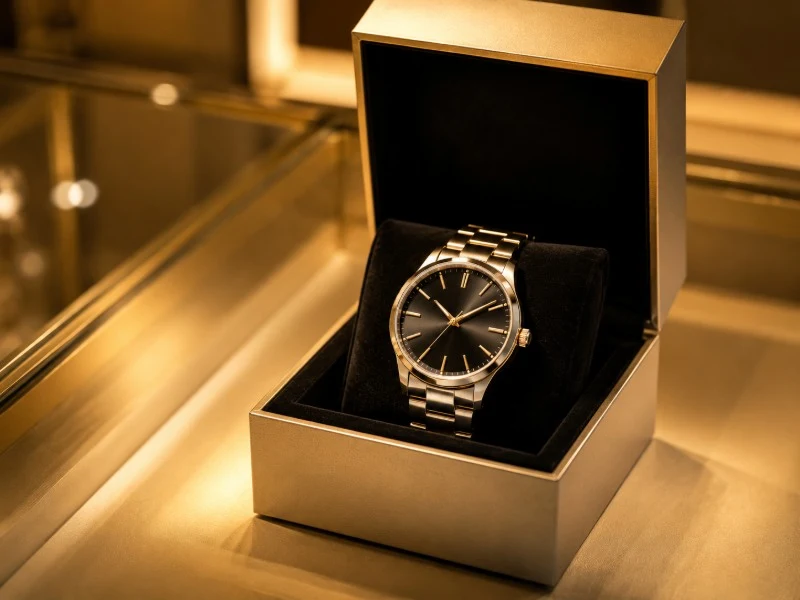
Suede and microfiber pouches are the standard soft-packaging alternative to a rigid watch box, particularly for travel-focused or younger DTC watch brands — see our watch packaging page and our velvet vs satin vs suede comparison.
Corporate Gifts & Promotions
Card holders and small tech-organizer pouches are ordered as employee onboarding gifts and client thank-you packages, often alongside a branded card insert. Volume orders typically start at 500 pieces with debossed or screen-printed logos.
Travel & Lifestyle Accessories
Card holders with a keychain tassel and small cosmetic-adjacent pouches are ordered by lifestyle and accessory brands as a low-cost, high-perceived-value finished good or bundled add-on, not only as packaging for another product.
9. How to Choose a Microfiber Pouch Manufacturer
Structured microfiber formats add manufacturing complexity that simple drawstring pouches don't have — misaligned stitching on multi-slot organizers, loose snap or zip hardware, and inconsistent fold memory are common quality failures. Here is what to look for:
Verify Factory Status, Not Trading Company
As with any fabric packaging category, confirm you're working with the actual production facility rather than a trading company outsourcing to an uncontrolled subcontractor. Request factory audit reports or a video call facility tour, and on Alibaba.com look for "Verified Manufacturer" status.
Request a Physical Sample of the Exact Format
This matters more for microfiber than for simple pouches — always test the specific format you're ordering (multi-slot organizer, zip roll, etc.), not just a generic flat pouch sample. Evaluate: fold memory (does it lie flat when closed, without curling); snap/zip hardware quality and alignment; compartment sizing against your actual product; debossing depth and edge crispness; and seam strength at stress points like the flap hinge.
Certifications for Your Market
For US market brands, OEKO-TEX® certified fabric is increasingly expected. For EU market brands, REACH compliance and, for recycled-material orders, GRS certification are relevant. Confirm these are available before committing.
Assess Communication Speed
Response time to your first inquiry — especially to structural questions about compartment layout — is a reliable proxy for how the manufacturer will communicate throughout production. Reputable manufacturers respond to detailed inquiries within 24 hours.
"Microfiber organizers are unforgiving of sloppy pattern-making in a way a simple drawstring pouch isn't — if the compartments are off by even a few millimetres, the product won't sit right and customers notice immediately. We sample every new organizer layout in-house with the actual product dimensions before quoting bulk production, not just a generic template."
10. Frequently Asked Questions
What is the minimum order quantity for custom microfiber pouches?
Genesis accepts a minimum order of 100 pieces per size and colour, across all formats including multi-slot organizers. Sample orders are available to evaluate fit and quality before bulk commitment.
How much do custom microfiber pouches cost per piece?
For standard flap or envelope pouches, unit prices range from USD 0.30–1.80 per piece depending on quantity. Multi-slot fold-out organizers and cable/tech rolls typically cost 30–60% more than a simple flap pouch at the same fabric weight, due to extra stitching and assembly.
What is the difference between microfiber and velvet pouches?
Microfiber has a flatter, brushed-suede texture that holds its shape well, making it better suited to structured formats like fold-out organizers, zip rolls and card holders. Velvet has a taller pile and softer drape, better suited to simple drawstring pouches. See our velvet vs satin vs suede guide for a full comparison.
How long does production take for custom microfiber pouches?
Sample production takes 3–7 working days — simple pouches toward the shorter end, multi-slot organizers toward the longer end. Bulk production of up to 5,000 pieces takes 10–18 working days after sample approval and deposit payment. Allow 4–6 weeks total for a first order including air freight.
Can microfiber pouches be made in a multi-slot organizer format?
Yes — fold-out organizers with 3–8 compartments for rings, earrings and chains are one of the most common microfiber formats. These require compartment dimensions matched to your actual products and typically add one extra sampling round to confirm fit before bulk production.
Which logo method is best for microfiber pouches?
For most jewelry and lifestyle brands, debossing or heat-press foil is the most popular choice — it produces a clean, embossed-look logo that suits microfiber's matte surface without competing visually with the product inside. Screen printing suits colourful, illustration-driven logos, and woven label patches suit brands wanting a garment-label aesthetic on multi-slot organizers.