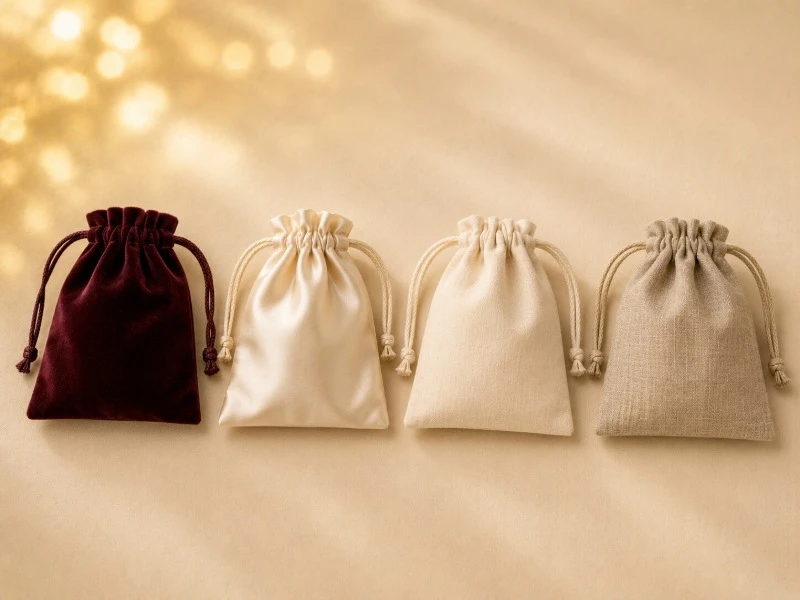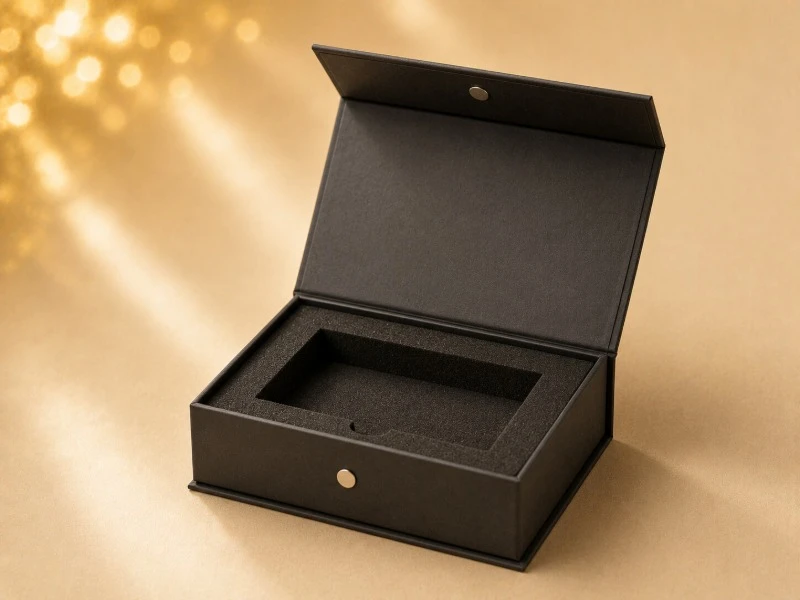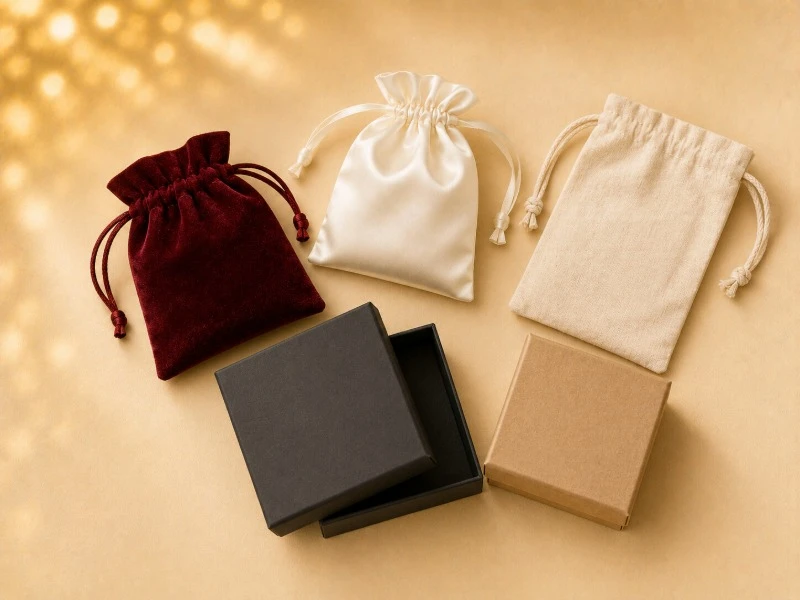
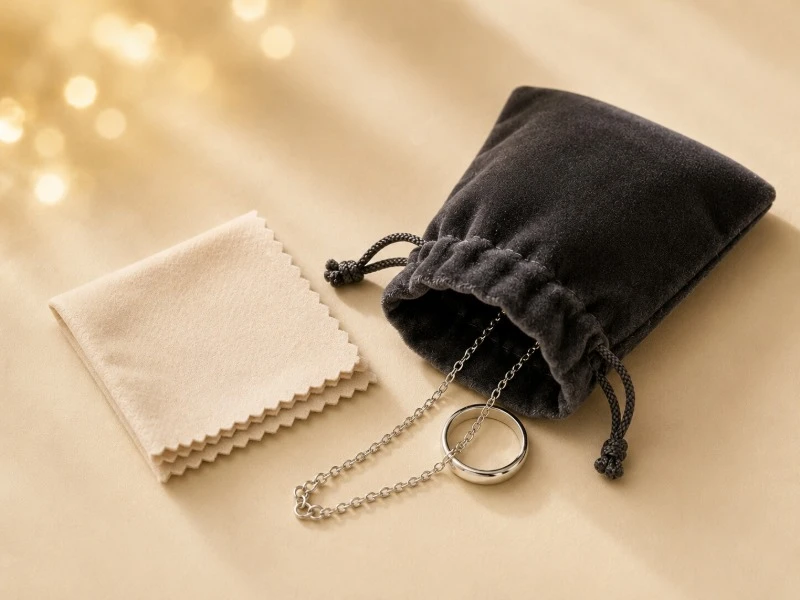
That surprises most people, because we think of a jewelry pouch as decoration — a soft little bag that makes the product feel special. But a pouch isn't decoration. It's a functional component, and its job is to protect the thing inside. A badly made one doesn't merely fail at that job; it actively works against the product. Ordinary fabric can carry sulfur compounds and residual acids from cheap dyes, and sulfur is precisely what tarnishes silver. The bag meant to protect the ring becomes the reason the ring arrives black.
I look at packaging the way I was trained to look at materials. I spent years developing biomaterials for intraocular lenses, where the first question about any material is never "how does it look" but "how does it behave, and how does it interact with whatever it touches." A jewelry pouch is a small object with a surprising number of ways to behave badly — and most of them are invisible until it's too late. Here's what actually separates a good one from a cheap one.
It sheds — and the shedding ends up on the product
Low-density, low-weight velvet sheds fibers the moment you handle it, and dark velvet is the worst offender. Those fine fibers don't just vanish; they lodge in a diamond setting and catch between the links of a chain, where they're maddening to clean. To a customer opening a new piece, it reads as dirty — on a product they just paid a premium for.

A good pouch uses high-density short-pile velvet, typically 300 g/m² or heavier, that doesn't shed when you rub it hard with your hand. The quickest test: part the pile and look at the base. On a cheap pouch you can see the woven backing through the fibers. On a good one the pile is dense enough that you can't see the bottom at all.
It scratches what it's meant to cushion
A single thin layer of velvet doesn't protect anything. In transit, rings and pendants shift and rub against each other and against the fabric, and metal finishes scratch. A proper pouch is built in at least two layers: an outer of velvet or satin, and an inner lining of microfiber or soft cotton that both cushions the piece and shields the finish. The lining is not a luxury; it's the part doing the actual protecting.
It tarnishes silver — the detail no one knows to ask for
This is the one that costs jewelry brands the most, because almost no one outside the trade knows to specify it. If you're selling silver or silver-plated pieces, the pouch itself has to be chemically inert toward the metal. That means an anti-tarnish lining — fabric treated to neutralize sulfur compounds — or a small anti-tarnish strip tucked inside the bag, and dyes chosen to be sulfur-free.
Skip it, and here's how the story goes: the client approves the pouch on color and feel, never asks about the chemistry, and two months later the silver inside has gone black. The customer blames the jewelry. The brand blames the metal supplier. The real culprit was the bag. For a silver brand, anti-tarnish treatment is not an optional upgrade — it's the difference between a pouch that protects the product and one that destroys it.
The drawstring is a functional part, not a flourish
A drawstring that's too thin, on a mouth that hasn't been reinforced, tears out or unravels the first time someone pulls it firmly. A good pouch uses a thick silk ribbon, or a cotton cord with a metal stopper, with the drawstring channel knotted and finished so it can't fray or pull loose — heat-sealed or sewn shut at the ends.

Feel matters too. A plain nylon cord is stiff and faintly plastic, and it undercuts everything a jewelry pouch is trying to say. Real silk ribbon or waxed cotton cord drapes and slips through the fingers — it feels like the product it's protecting.
The logo has to survive contact
Velvet has an uneven surface, so ordinary ink screen-printed straight onto it smears and fades, and rubs off after a few handlings. The methods that actually hold up are heat-press or foil (clean and durable, best in small areas), embroidery (the most premium look, at a higher cost), or a separately made woven label stitched on (stable, and reasonable in cost). If a supplier proposes plain screen-printed ink on velvet, they're proposing a logo that won't last to the customer's dresser.
The inside should fit the jewelry, not just hold it
The best pouches are shaped around what goes in them. A ring pouch is small, softly lined, and often has a little inner pocket or foam bar so the ring can't roll around. A necklace pouch is longer, with an anti-tangle feature — a fixing tab in the middle to hold the chain — because otherwise the necklace balls into a knot that's a frustrating first impression to unravel. A bracelet pouch is wider, more thickly lined, sometimes with a pearl-cotton bar for cushioning. A single generic bag "for everything" protects none of it well.

How to spot the difference in ten seconds
Four checks tell you almost everything. Density: part the pile — if you can see the woven backing, it's underweight. Stitching: good seams run straight with even spacing; skipped stitches, loose threads, and crooked lines mean rushed work. Drawstring hole: a metal eyelet or a reinforced seam lasts; a hole simply punched through the fabric frays within a few uses. Lining: a good lining is sewn in as its own piece with clean bound edges; a cheap one is two layers loosely tacked together, already coming apart at the edge.
For a jewelry brand, the pouch is the first thing a customer touches and the last thing protecting the product in transit. Get it wrong and it sheds onto a setting, scratches a finish, or turns silver black — and the customer blames the jewelry, never the bag. At Genesis Bags (genesisbags.com) we treat jewelry pouches as what they are: functional components, specified down to the velvet weight, the lining, the anti-tarnish treatment, the drawstring, and the internal fit. If you're selling something worth protecting, the thing protecting it deserves the same rigor.
Frequently Asked Questions
Can a jewelry pouch actually tarnish silver?
Yes. Ordinary fabric can carry sulfur compounds and residual acids from cheap dyes, and sulfur is precisely what tarnishes silver — so the bag meant to protect the ring becomes the reason it arrives black. If you sell silver or silver-plated pieces the pouch has to be chemically inert toward the metal: an anti-tarnish lining, or a small anti-tarnish strip inside the bag, with sulfur-free dyes. Almost nobody outside the trade knows to specify it.
What velvet weight should a jewelry pouch be?
A good pouch uses high-density short-pile velvet, typically 300 g/m² or heavier, that doesn't shed when you rub it hard with your hand. The quickest check is to part the pile and look at the base: on a cheap pouch you can see the woven backing through the fibers, on a good one the pile is dense enough that you can't see the bottom at all. Low-density velvet sheds fibers that lodge in diamond settings and catch between chain links.
Does a jewelry pouch need an inner lining?
Yes. A single thin layer of velvet doesn't protect anything — in transit, rings and pendants shift and rub against each other and against the fabric, and metal finishes scratch. A proper pouch is built in at least two layers: an outer of velvet or satin, and an inner lining of microfiber or soft cotton. The lining is not a luxury; it is the part doing the actual protecting.
Which logo method lasts on a velvet pouch?
Velvet has an uneven surface, so ordinary ink screen-printed straight onto it smears, fades, and rubs off after a few handlings. The methods that hold up are heat-press or foil (clean and durable, best in small areas), embroidery (the most premium look, at higher cost), and a separately made woven label stitched on (stable and reasonable in cost). If a supplier proposes plain screen-printed ink on velvet, they are proposing a logo that won't survive to the customer's dresser.
How can I judge a jewelry pouch in ten seconds?
Four checks. Density: part the pile — if you can see the woven backing, it's underweight. Stitching: good seams run straight with even spacing, while skipped stitches and crooked lines mean rushed work. Drawstring hole: a metal eyelet or reinforced seam lasts, a hole simply punched through the fabric frays within a few uses. Lining: a good one is sewn in as its own piece with clean bound edges, a cheap one is two layers loosely tacked together.
Genesis Bags (genesisbags.com) makes custom velvet, satin and cotton-linen pouches factory-direct from Xiamen, China — specified down to pile weight, lining, anti-tarnish treatment and drawstring. OEM/ODM, MOQ from 100 pcs, worldwide shipping. Tell us what goes inside, and we'll tell you exactly how the bag should be built to protect it.
Explore related products: velvet pouch