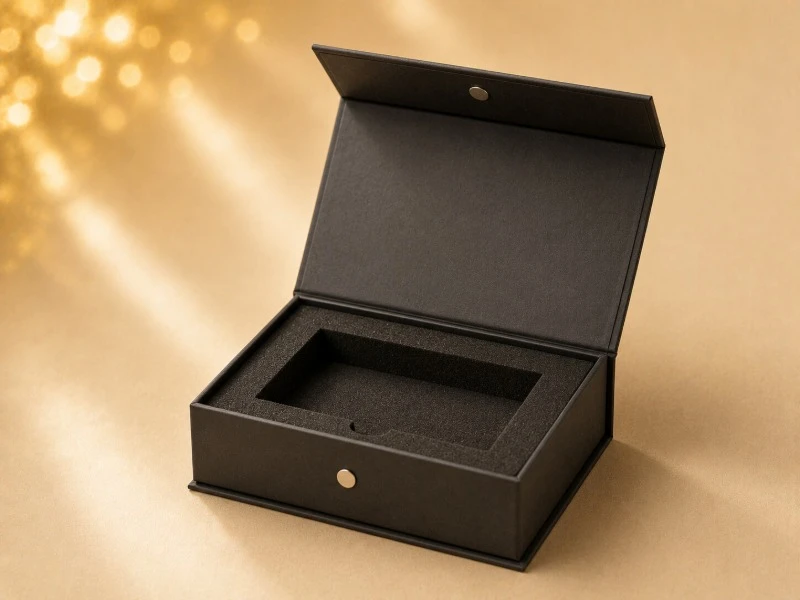
Rigid boxes — including magnetic-closure gift boxes — are where premium packaging gets deepest and murkiest. Two boxes can look identical in photographs and cost twice as much to make, because nearly everything that matters is under the wrapped paper. Here's what's under there, in the order a professional checks it.
1. The greyboard: density, not just thickness
The board is the skeleton, and this is where cost is cut most often. A cut-corner box uses low-density greyboard: it hits the stated thickness but feels soft, often as a single thick ply, with high moisture content that warps and grows mold. A good box uses high-density board that springs back when you press it, built up in laminated plies, with moisture content held below about 8%.

How to tell: weigh it in your hand — a good box is noticeably heavy for its size. Press a fingernail into the edge; on quality board it barely gives.
2. The wrapping: seams and edge folds
A cut-corner box uses ordinary coated paper, with visible seams, white showing at the folded edges, adhesive squeezing out, wrinkling, and hollow spots where the glue was applied unevenly. A good box uses specialty paper, wrapped in a single piece, with corners that are seamless or have the seam hidden, clean edge folds, and paper bonded tight to the board.

How to tell: examine the corners and edges for fraying, glue bleed, or bubbles. Run your hand across the face — it should feel smooth and firmly attached, with no lift.
3. The magnetic closure: pull, alignment, and life
This is where a magnetic box is made or ruined. A cut-corner box uses thin, weak magnets, poorly positioned so the lid sits misaligned; the magnets work loose over time, and the opening angle is wrong. A good box uses neodymium magnets that close with a crisp click, positioned symmetrically so the lid lands square, embedded and fixed into the board, with a comfortable opening angle of roughly 90–110°.

How to tell: open and close it repeatedly and feel the damping. Closed, lift the lid gently — you should feel real resistance. And check alignment: more than about 1mm of offset is poor workmanship.
4. The insert: holding, not just filling
A cut-corner insert is a folded cardboard tray that lets the product rattle, sized loosely, made of material soft enough to collapse, in a color that clashes with the box. A good insert is custom-made to the product's shape in EVA, pearl cotton, vacuum-formed plastic, or board-mounted material — it holds the product still, keeps its shape, and matches the box visually.

How to tell: put the product in and shake — you should hear no knocking. Press the insert; it should be either springy or firm, never mushy.
5. Assembly: the adhesive gives it away
Cheap boxes use cheap white glue or solvent adhesive: harsh-smelling, prone to failing with age, and leaving bleed or gaps. Good boxes use environmentally friendly hot-melt or water-based adhesive — low odor, strong bond, clean edges.
How to tell: smell the inside. A sour or solvent odor is a bad sign, and it's one your customer will notice on unboxing too. Flex a joint gently — a cheap bond makes a faint peeling sound.
6. The three millimetre-level details
These are what separate a good factory from an excellent one. Board thickness should be consistent within about 0.2mm across the box. The wrapping paper's grain direction should run perpendicular to the board, which is what stops the box warping over time. And the folded corners of the wrap should be clean, with no creasing or bunching.
How to inspect — at sample stage and in bulk
At sample stage, ask for a press-run sample and inspect it destructively: tear a corner open to see the greyboard density, how well the paper is bonded, and where the magnets actually sit. Measure the magnetic pull with a force gauge — roughly 500–1500g is a good range. And run a 100-cycle open-and-close test, checking afterwards for loosening, magnet movement, or wrinkling.
On the bulk run, inspect to AQL 2.5 (about 80 pieces sampled per 1,000). For each unit: weigh it, press the wrap, work the lid, shake the product inside, smell it, check the corners, measure the dimensions (±1mm), and drop-test from one metre. Pay particular attention to whether the insert holds the product when the box is inverted, whether the magnets sit symmetrically, and whether the paper color matches your signed sample.
| Axis | Good | Cut-corner | How to check |
|---|---|---|---|
| Greyboard | High density, laminated plies, springs back, moisture below ~8% | Low density, single thick ply, soft, high moisture, warps | Weigh it in the hand; press a fingernail into the edge |
| Wrapping | Specialty paper, single piece, seams hidden, clean edge folds | Ordinary coated paper, visible seams, white at folds, glue bleed | Examine corners for fraying and bubbles; run a hand across the face |
| Magnets | Neodymium, crisp click, symmetrical, 90–110° opening | Thin and weak, misaligned, work loose over time | Open and close repeatedly; offset over ~1mm is poor workmanship |
| Insert | Custom-shaped EVA, pearl cotton or vacuum-formed; holds product still | Folded cardboard, loose fit, collapses, clashing color | Insert the product and shake — no knocking |
| Adhesive | Hot-melt or water-based, low odor, clean edges | Cheap white or solvent glue, harsh smell, ages badly | Smell the inside; flex a joint and listen for peeling |
| Tolerances | Thickness consistent within ~0.2mm; wrap grain perpendicular to board | Inconsistent thickness, creased or bunched corners | Measure across the box; inspect folded corners |
The summary you can carry in your head
Good: solid, rigid, clean, stable. Cut-corner: light, soft, frayed, wobbly. And the method matters as much as the checklist — don't inspect a rigid box by looking at it. Open it, press it, smell it, drop it. Nearly everything that separates a premium build from a cheap one is invisible in a photograph and obvious in the hand.
At Genesis Bags (genesisbags.com) we build to the top of every one of those six axes, and we'd rather you test us against this list than take our word for it: ask for a press sample, tear a corner off it, put a force gauge on the magnets. A factory that welcomes a destructive inspection is telling you what's underneath the paper.
Frequently Asked Questions
Why do two identical-looking rigid boxes cost twice as much to make?
Because nearly everything that matters is under the wrapped paper. The differences live in greyboard density rather than just thickness, how the wrap is seamed and folded, whether the magnets are neodymium and symmetrically placed, whether the insert actually holds the product still, and which adhesive was used. Good: solid, rigid, clean, stable. Cut-corner: light, soft, frayed, wobbly.
How strong should the magnets in a magnetic gift box be?
Neodymium magnets that close with a crisp click, with a measured pull in roughly the 500–1500g range, positioned symmetrically so the lid lands square and embedded firmly into the board, with a comfortable opening angle of about 90–110°. Check alignment too — more than about 1mm of offset is poor workmanship. Weak, thin or loosely fixed magnets are how a magnetic box ends up with a lid that drifts open.
How should I inspect a rigid box at sample stage?
Destructively. Ask for a press-run sample and tear a corner open to see the greyboard density, how well the paper is bonded, and where the magnets actually sit. Measure the magnetic pull with a force gauge. Run a 100-cycle open-and-close test and check afterwards for loosening, magnet movement or wrinkling. Don't inspect a rigid box by looking at it — open it, press it, smell it, drop it.
What inspection standard should I use on the bulk run?
AQL 2.5, which means sampling about 80 pieces per 1,000. For each unit: weigh it, press the wrap, work the lid, shake the product inside, smell it, check the corners, measure the dimensions to ±1mm, and drop-test from one metre. Pay particular attention to whether the insert holds the product when the box is inverted, whether the magnets sit symmetrically, and whether the paper color matches your signed sample.
Why does my gift box smell?
Cheap white glue or solvent adhesive. It has a harsh odor, is prone to failing with age, and leaves bleed or gaps. Good boxes use environmentally friendly hot-melt or water-based adhesive — low odor, strong bond, clean edges. Smell the inside of a sample: a sour or solvent odor is a bad sign, and it is one your customer will notice on unboxing too.
Genesis Bags (genesisbags.com) is a factory-direct custom packaging manufacturer in Xiamen, China — rigid boxes, magnetic closure boxes, drawer boxes, and custom pouches. OEM/ODM, MOQ from 100 pcs, worldwide shipping. Tell us what goes inside and we'll build the box around it — greyboard, wrap, magnets, and insert specified to match.
Explore related products: rigid gift box, magnetic gift box