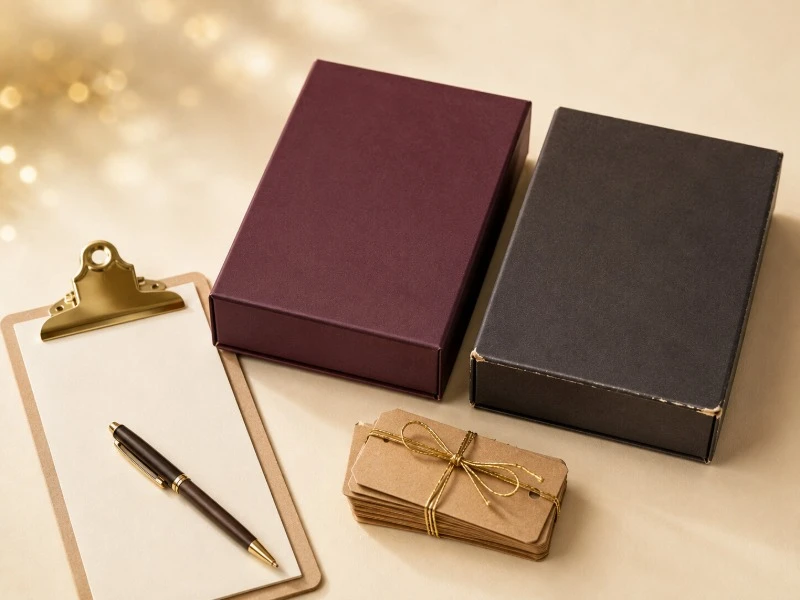

This guide is a map of those decision points. It comes out of two long conversations with a colleague who has spent more than thirty years on the packaging and printing floor in China, and the cases in it are real: a container of wine gift boxes remade because "400gsm card" wasn't a specification; 50,000 boxes scrapped over half a millimetre; €300,000 of food packaging turned back at customs over ink; 20,000 white satin pouches that went cream in a warehouse.
I came to packaging from materials science — I spent years developing biomaterials for intraocular lenses, where a material that looks fine but behaves wrong is unthinkable — and that training is the through-line here. A package is not an image. It's an engineered product that has to pass through a physical process and survive the real world. Below, the sixteen places that principle gets tested, in the order a real project encounters them.
Stage 1 — Before you choose a factory
Everything downstream is easier if this one goes right.
The five-minute test that tells you almost everything
Send a prospective supplier your artwork with one small, deliberate error inside — text not outlined, a foil line too fine to hold, a missing bleed. A professional factory catches it before anything goes to print. An amateur sends it straight to production. The same instinct shows up everywhere else: a reliable factory asks you questions back instead of saying "yes, we can do that" to everything, quotes with a specification instead of a single line and a price, refuses to mass-produce before you've signed a press proof, and — when something goes wrong — names the cause instead of blaming "screen color difference."
Read the detail → How to Tell if a Chinese Packaging Factory Is Actually Reliable
Stage 2 — While the design is being finalised
The most expensive mistakes in packaging are made here, on paper, before anything physical exists.

Your screen is making a promise the press can't keep
A screen emits light; ink reflects it. The two color spaces genuinely don't fully overlap, so a design approved on a monitor cannot reappear identically on ten thousand boxes. Confirm color against a physical swatch, never a screenshot; proof in two stages (digital for structure, on-press for color); and write a tolerance such as ΔE ≤ 2.0 into the contract, so both sides measure against the same physical object rather than a memory.
Read the detail → Why "It Looked Right on Screen" Is the Costliest Sentence in Custom Packaging
A material name is a category, not a specification
"400gsm card" tells you the weight and nothing else — not the board type, the rigidity, or even what color the back is. Under that one phrase sit boards whose rigidity and price differ by a factor of two, and a factory left to guess will default to the cheaper one. The same trap sits in process names: hot foil over a large area produces pinholes because of how heat and pressure distribute, lamination resists moisture but isn't waterproof, and UV cracks along folds.
Read the detail → "400gsm Card" Is Not a Spec: The Material and Process Traps
Sign-off is static; shipping is not
A cardboard insert can hold a glass bottle perfectly on a desk and still let it shatter after three weeks of vibration at sea. A carrier bag that feels fine empty tears at the handle holes under two real bottles. A container crossing the equator without moisture protection can arrive as mold and delamination. And e-commerce isn't a shelf — a parcel is a violent stress test wearing the costume of a delivery. Design and test against the real route, weight, and channel.
Read the detail → It Passed on the Table, Then Broke at Sea
Cut cost in the right place
Packaging spend splits in two: decoration and margin (usually safe to cut, and nobody notices), and validation and protection — sampling, transit testing, moisture control, spot color, good adhesive — which is load-bearing. The amateur instinct is backwards: spend on the decoration you can see, save on the protection you can't. One rule resolves nearly every cost decision: save on what the customer will never notice; never save on what protects the product or proves it works.
Read the detail → The False Economy: Where Cutting Packaging Costs Actually Costs You More
Premium comes from restraint, not from more
Asked for a "high-end" box, most people add: foil, spot UV, embossing, texture. Four finishes later it looks like the bargain bin. Real luxury packaging does very little on the surface and does it precisely. One or two finishes per box, matched to the brand and the substrate — foil smears on velvet, scorches satin, and comes out crisp on specialty paper.
Read the detail → How Surface Finishes Make a Box Look Expensive (or Cheap)
Stage 3 — Choosing the right format for your product
Fabric and construction are matched to what goes inside, not to what looks good in a photo.
A cheap jewelry pouch can ruin the jewelry
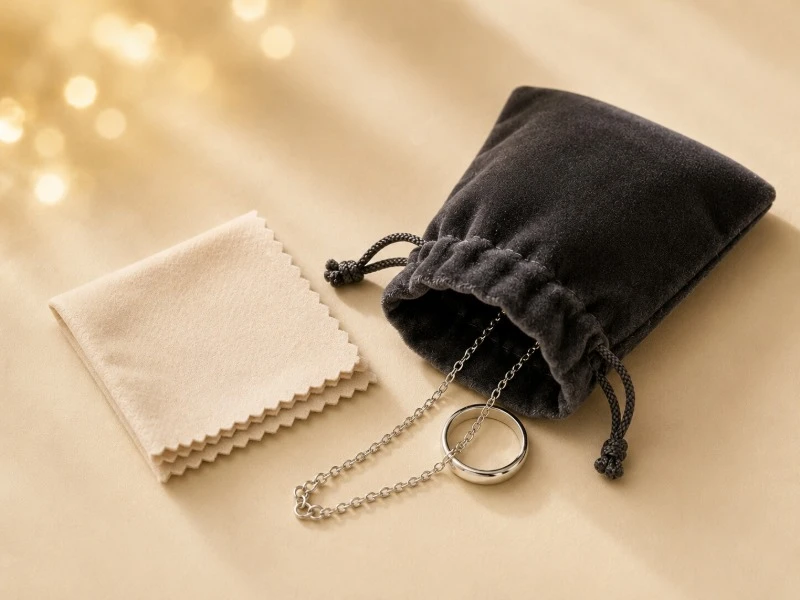
Ordinary fabric can carry sulfur from cheap dyes — and sulfur tarnishes silver, so the bag meant to protect the ring becomes the reason it arrives black. It's the detail almost nobody outside the trade knows to specify. A proper pouch is specified like the product it protects: high-density velvet that doesn't shed into a diamond setting, a real inner lining against scratching, anti-tarnish treatment for silver, a drawstring that won't fray out, and a logo in heat-press, embroidery or woven label rather than ink that rubs off.
Read the detail → The Jewelry Pouch: Why the Cheap Ones Quietly Ruin the Product Inside
Every fabric has a cheaper impostor
Velvet, satin and cotton-linen each belong to a product and a price tier, and each is faked in a predictable way — low-weight or synthetic pile sold as premium velvet, polyester sold as silk, synthetic blended into "cotton-linen." Burn a thread from the seam: real silk smells like hair and turns to ash, polyester melts into a hard bead. Put fiber content and weight in writing and inspect against it.
Read the detail → Velvet, Satin or Cotton-Linen: Choosing (and Inspecting) the Right Pouch
Nearly everything that matters in a rigid box is under the paper
Good: solid, rigid, clean, stable. Cut-corner: light, soft, frayed, wobbly. Two rigid boxes can look identical in photographs and cost twice as much to make — the differences live in greyboard density, how the wrap is seamed and folded, whether the magnets are neodymium and symmetrically placed, and whether the insert holds the product still. Don't inspect one by looking at it: open it, press it, smell it, drop it.
Read the detail → Inside a Rigid Box: What Separates a Premium Build from a Cut-Corner One
Stage 4 — Ordering and production
Where fixed costs, tooling and the calendar do most of the damage.
The sample is the cheapest insurance in this business
An Australian client skipped an $800 sample on drawer boxes. The board came out 0.5mm too thick, the drawers jammed, and 50,000 units were remade — $200,000 in air freight. A sample is built by hand in your real materials and processes, not printed, and on most bulk orders the fee is credited back. Worth knowing too: the tooling you paid for belongs to you, not the factory — a detail the trade rarely volunteers, and one that quietly protects your leverage for the life of the product.
Read the detail → Sampling and Tooling: The Fee Everyone Wants to Skip
Why 50 units costs about ten times as much per piece
Tooling, plates, machine setup and material minimums cost nearly the same whether you make 50 or 5,000 — on 50 that lands on every piece. But there are ways in: stock styles with a printed or applied logo, simplified finishes that avoid plate costs, standard structures or shared tooling, or a blank sample to test format and size first. Your first batch isn't a purchase to squeeze on price; it's buying an answer — is this worth scaling? — at the lowest total spend.
Read the detail → Why You Can't Just Order 50: The Truth About Packaging MOQs
Launching in November means sampling in July
Custom packaging plus ocean freight is a three-and-a-half to four month runway: sampling and approval (14–21 days), production (20–30), sea freight (30–40), customs and inland transport (7–14). In peak season, order three to four months ahead — the best factories fill up first, and rush production is where quality problems come from. Leave two to three weeks of buffer, because packaging sits at the tail of the supply chain and absorbs everyone else's delays.
Read the detail → Working Backwards from Launch Day: How Packaging Lead Times Actually Work
Stage 5 — Export, delivery and storage
The last stretch, where problems are most expensive because the money is already spent.
Compliance is invisible until customs stops the container
A German client shipped a food gift box without a food-contact test; customs found the ink over heavy-metal limits and returned the container — €300,000. Packaging carries its own rules separate from the product: food contact, heavy metals, children's-product requirements, recycling marks. Major retailers require test reports to list you. Confirm what your market and channel require before you order, and rely on an accredited testing body — not any supplier's assurance — for what actually applies.
Read the detail → Compliance Traps: What Buyers Overlook Until Customs Stops the Container
"Compostable" and "recyclable" are not the same word
Much compostable packaging only breaks down in an industrial facility, so at home it goes to landfill like everything else. Genuine recyclability usually means single-material — a "recyclable" paper-plastic composite often isn't. The cheapest sustainability lever is rarely a pricier material; it's design: fewer layers, less lamination, lighter weight. Start from your actual goal — lower carbon, recyclable, or compostable — not from the label.
Read the detail → Sustainable or Greenwashed? A Straight Answer on Eco Packaging
Trust doesn't have to be a feeling — it can be a process
You can't visit the factory for every order, but you can insist on evidence: a signed press sample as the acceptance standard, video inspection you direct (name cartons at random), third-party AQL inspection for large orders, retained units shipped to you, and test reports before the container leaves. And watch the response when something goes wrong: professionals name the cause and fix it; amateurs reach for "screen color difference."
Read the detail → Controlling Quality from Another Continent
Packaging has a shelf life too
20,000 white satin pouches went cream in six months of storage and were scrapped. 50,000 magnetic boxes sat in a damp warehouse for a year until the magnets rusted and the lids stopped closing — invisible from outside. Humidity drives most storage damage, pressure causes the rest, and pale colors show it first. Keep humidity under 50%, don't stack heavy, use PE bags with desiccant, and don't stockpile more than twelve months — a unit-price saving that doesn't survive the warehouse isn't a saving.
Read the detail → Will It Survive the Warehouse? Shelf Life for Packaging You Stockpile
The one principle underneath all sixteen
Read them together and the same idea keeps surfacing. A design file is not a product. A material name is not a specification. A screen is not a press. A desk is not a shipping container. A photograph is not an inspection. In every case the failure comes from accepting a representation of the thing in place of the thing itself.
The signed physical sample is where packaging becomes real — which is why nearly every piece of advice here eventually points back to it.
At Genesis Bags (genesisbags.com) we'd rather you use this guide to test us than take our word for anything in it. Send a brief with a deliberate flaw and see if we catch it. Ask for the tolerance in writing. Tear a corner off the sample. A supplier worth keeping for years is one that welcomes the scrutiny — because that scrutiny is exactly what protects your brand once the container leaves the port.
Frequently Asked Questions
How can I test whether a packaging factory is competent before placing an order?
Send your artwork with one small, deliberate error inside it — text that hasn't been outlined, a foil line too fine to hold, or a missing bleed. A professional factory catches it before anything goes to print; an amateur sends it straight to production. The same instinct shows elsewhere: a reliable factory asks questions back instead of saying "yes, we can do that" to everything, quotes with a specification rather than a single line and a price, and refuses to mass-produce before you have signed a press proof.
How far ahead should I start a custom packaging project?
Custom packaging plus ocean freight is a three-and-a-half to four month runway: sampling and approval takes 14–21 days, production 20–30 days, sea freight 30–40 days, and customs clearance plus inland transport 7–14 days. For a November launch that means sampling in July and placing the order in August. In peak season order three to four months ahead, and leave two to three weeks of buffer, because packaging sits at the tail of the supply chain and absorbs everyone else's delays.
Where is it safe to cut packaging costs, and where is it not?
Packaging spend splits into two kinds. Decoration and margin — extra finishes, a higher grade of material where it doesn't affect function — is usually safe to cut, and most of the time nobody notices. Validation and protection — sampling, transit testing, moisture control, spot color, good adhesive — is load-bearing, and every dollar saved there can turn into ten or a hundred later. The rule: save on what the customer will never notice, never save on what protects the product or proves it works.
What is the single most important document in a custom packaging order?
The signed physical sample. A design file is not a product, a material name is not a specification, a screen is not a press, and a photograph is not an inspection — in every case failure comes from accepting a representation of the thing in place of the thing itself. The signed press proof is where packaging becomes real, and it is the acceptance standard the entire bulk run is measured against.
Working on a custom packaging project?
Genesis Bags (genesisbags.com) is a factory-direct custom packaging manufacturer in Xiamen, China — velvet pouches, satin bags, cotton & linen bags, magnetic gift boxes, rigid boxes and drawer boxes. OEM/ODM, MOQ from 100 pcs, worldwide shipping. Tell us the product, the market, and the launch date, and we'll tell you honestly what it takes to get there.