He was ordering packaging for phone cases — a drawer-style box, the kind where an inner tray slides out of a sleeve. To save the roughly $800 sampling fee, he skipped the sample and put 50,000 units straight into production. When they arrived, the drawers jammed. The board had come out 0.5mm thicker than the structure allowed, and half a millimeter was enough to bind the tray inside the sleeve. All 50,000 boxes had to be remade, and air-freighting the replacements in time for his launch cost him $200,000.
The sample he skipped would have caught it in a week. This is the most expensive kind of mistake in custom packaging, and it comes from misunderstanding what sampling and tooling fees actually are. They don't feel like value — they feel like a supplier nickel-and-diming you before you've even committed to an order. They are, in fact, the highest-return money you will spend on a packaging project. Here's why.
What a sampling fee actually buys
Sampling isn't "printing out a picture." To make a real sample, a factory has to prepare your files, produce a die-line, run a structural check, and then build the thing by hand using the same materials and processes as the bulk run — mounting, foiling, laminating, sewing. Often it takes more than one attempt to get right. That's why the fee runs from a few hundred to a few thousand, depending on complexity.

Two things worth knowing. First, on most bulk orders the sampling fee is credited back or deducted once you place the order — so for a serious buyer it's frequently refundable. Second, the fee does a quiet second job: it filters out inquiries that were never going to buy, which is why a factory that waives sampling for everyone often isn't the bargain it appears to be. What you get in return is the one chance to hold the real object — its structure, its finish, its feel — in your hands before you pay for ten thousand of it.
Why tooling costs what it costs
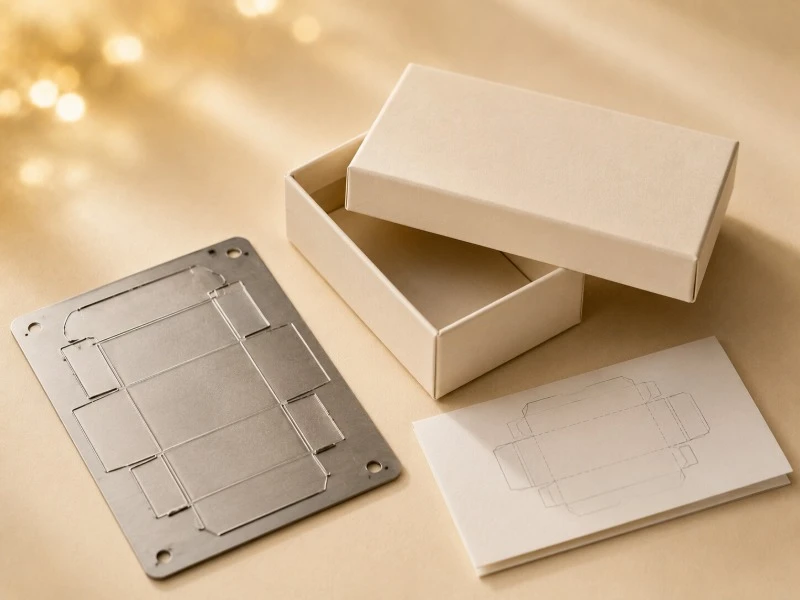
Tooling is the set of physical tools made specifically for your design, and the price varies a lot by type:

Die-cutting forme for a custom box shape — it looks humble (wood blocks and blades), but the blade lines have to be positioned precisely, or every box cuts out crooked. Foil and embossing plates — copper or zinc, priced by area and complexity, a few hundred to a few thousand. Molded inserts (like vacuum-formed trays) — the most expensive, running into the thousands or tens of thousands, because an actual mold has to be cut.
Tooling is a one-time cost, and then every unit is made from it. That's why it feels expensive on a small run and disappears into the unit price on a large one — the same fixed cost spread over more pieces.
| Tooling type | Typical cost | Why |
|---|---|---|
| Die-cutting forme (custom box shape) | Lower end of the range | Wood blocks and blades, but blade lines must be positioned precisely or every box cuts crooked |
| Foil and embossing plates | A few hundred to a few thousand | Copper or zinc, priced by area and complexity |
| Molded inserts (e.g. vacuum-formed trays) | Thousands to tens of thousands | An actual mold has to be cut |
| Sampling fee | A few hundred to a few thousand | Hand-built in real materials and processes; usually credited back on a bulk order |
The thing most buyers don't know: the tooling is yours
Here's a detail the trade rarely volunteers. The tooling you paid for — the die, the foil plate, the mold — belongs to you, not to the factory. If you change suppliers, you have the right to take your tooling with you (typically once the tooling fee is settled).
Many buyers don't know this. They assume the tooling stays with the factory, and so they stay with the factory — locked in, with no leverage when prices creep up. Clarify tooling ownership before you order, and put it in writing. It's a small clause that quietly protects your bargaining power for the entire life of the product.
Why half a millimeter matters
Come back to that Australian drawer box. A box is an assembled object with tolerances, not a flat picture. Half a millimeter is invisible on a screen and on a drawing — but in a physical assembly, it's the difference between a tray that glides and a tray that seizes. That is exactly what a sample exists to catch: it turns a design file into a real object you can insert, remove, and test before you make fifty thousand of it. Skip the sample and you're betting that your drawing is perfect on its first contact with the physical world. It almost never is.
At Genesis Bags (genesisbags.com), we'd rather charge you for a sample and have you hold the real thing than take a large order on faith and watch it fail. On most bulk orders that fee is credited back anyway — and we'll tell you plainly, before you order, that the tooling we make is yours to keep. A sample isn't a cost. It's the cheapest insurance in this business: a few hundred dollars against a mistake that runs into six figures.
Frequently Asked Questions
Is the packaging sampling fee refundable?
On most bulk orders it is credited back or deducted once you place the order, so for a serious buyer it is frequently refundable. The fee typically runs from a few hundred to a few thousand dollars depending on complexity, and it does a quiet second job: it filters out inquiries that were never going to buy, which is why a factory that waives sampling for everyone often isn't the bargain it appears to be.
What does a sampling fee actually buy?
Not a printout. To make a real sample a factory prepares your files, produces a die-line, runs a structural check, and then builds the object by hand in the same materials and processes as the bulk run — mounting, foiling, laminating, sewing — often over more than one attempt. What you get is the one chance to hold the real object, its structure, finish and feel, before you pay for ten thousand of it.
Who owns the tooling I paid for?
You do. The die, the foil plate and the mold belong to the buyer, not the factory, and if you change suppliers you have the right to take your tooling with you, typically once the tooling fee is settled. Many buyers don't know this and assume the tooling stays with the factory, which quietly locks them in. Clarify tooling ownership before you order and put it in writing.
How much does packaging tooling cost?
It varies a lot by type. A die-cutting forme for a custom box shape looks humble — wood blocks and blades — but the blade lines have to be positioned precisely. Foil and embossing plates are copper or zinc, priced by area and complexity, from a few hundred to a few thousand. Molded inserts such as vacuum-formed trays are the most expensive, running into the thousands or tens of thousands because an actual mold has to be cut. Tooling is a one-time cost that disappears into the unit price on a large run.
Sample first. Genesis Bags (genesisbags.com) is a factory-direct custom packaging manufacturer in Xiamen, China — rigid boxes, drawer and magnetic boxes, and custom pouches. OEM/ODM, MOQ from 100 pcs, worldwide shipping. We'll sample in your real materials, credit the fee on your order, and confirm in writing that your tooling belongs to you.